What AI does to every profession and the question my own industry can't answer.
A young consultant asked me how AI would change our job. I remember being surprised because to me the answer seemed obvious, and I assumed it was obvious to him. He's sharp. He uses the tools every day. Why couldn't he see it?
Then I started paying attention, and the surprise turned into something less comfortable. The junior wasn't the exception. Managers ask it. Partners ask it. The firm asks it in town halls and strategy offsites. And the market asks it loudest of all: In June 2026 Accenture had the worst single day in its history as a public company — its stock down nearly twenty percent in one session, on a soft outlook and Wall Street's blunt verdict that AI is eating into consulting demand. And Capgemini and the rest of the sector slid alongside it.¹ It was that very same question — what is your work worth once everyone has AI — priced in by people with billions on the line.
Almost no one has an answer they actually believe. So let me give you mine. It's simpler than the panic suggests, and it's both worse and better than the optimists pretend.
The stack
Strip away the org charts and the buzzwords, and any capability — a consulting practice, a law firm, a radiology department, a software team — is three things stacked together: people, process, and tools.
For most of business history you could differentiate on any of the three: A sharper method, a better tool, stronger people. The mix shifted, but all three were in play.
Technology has been quietly pulling layers out of that stack for decades, from the bottom up. It disguised itself as a tool and then took the process first. This is the part my own industry doesn't like to say out loud. The demand-management process at one chemical company is, in every way that matters, the demand-management process at the next. SAP made sure of it; Thomas Davenport warned a quarter of a century ago that an enterprise system imposes its own generic logic on the business that installs it.⁴ And once a process is fully encoded in software, it stops being anyone's advantage. It now lives in the tool, available to all.
We knew this, and we sold the opposite story. We told middle managers they were unique, and we billed billions to customize, align, and change-manage that uniqueness into the standard system. After years inside this circus, I bet that from all those programs, the only functions that survived are the standard ones. The rest was paid resistance to a convergence that was going to happen anyway.
Convergence doesn't negotiate
Because convergence isn't a trend. It's closer to entropy: a direction the world moves in whether or not you approve. You can slow it, you can dress it up, you can charge for the delay. You cannot run it backwards.
Process went first. Now it's the tools' turn, and AI is the agent. When every firm runs the same frontier models — and they will; mine is rolling them out to everyone as I write this — the tool stops being an edge and becomes a floor. "Good with Excel" was once enough to start a career in my field. Soon "good with Claude" will mean just as little, and for the same reason: when everyone has it, having it sets no one apart.
Tool skill doesn't vanish, to be clear. It moves. It stops mattering which spreadsheet or which model you prefer, and starts mattering whether you understand the thing well enough to know its limits, where it's dangerous, and how to handle it. But look closely at what that is: it isn't tool skill anymore. It's judgement about a tool. We've already climbed off the bottom of the stack without noticing.
The kick in the head
I didn't reach the answer by staring at the problem. I reached it sideways, through something I'd been building for a different reason.
For most of a year I'd been writing a personal discipline for delegating work to AI — when to hand a task to a machine, and when to keep it; a short set of laws of delegation. And one of them hit a lot harder than the others: before you delegate anything, ask who bears the consequence when the machine gets it wrong.
Sit with that long enough and it stops being about AI at all. The machine can produce the work but it cannot hold the consequence. It cannot be the one who answers for a bad call to a board, a missed tumor, a flawed filing. Accountability is not a task you can route to a model. Someone human is always standing underneath it.
That was what kicked me in the head.
The human factor
Follow the "who bears the consequence" thought and you arrive at the small set of things that don't converge — the part of the stack technology keeps failing to absorb. I'd name it as three, with a fourth that binds them.
- Judgement: deciding what is worth doing and what is true, the taste to tell the good from the dressed up BS.
- Empathy: connecting with the other human, the need that sits in no document.
- Experience: the scar tissue, the "I have watched this exact plan fail at three companies."
And holding them together, accountability: the willingness to own the outcome.
This is the human factor. When the tools converge into one and the same, and the process dissolved into software long ago, the human factor is the only layer of the stack still able to tell two people, or two firms, apart. Everything that converged now prices at cost. Whatever margin and meaning are left have collected here.
Be careful: The human factor is a receding frontier. Drafting felt deeply human five years ago; today a model does a passable first pass. So the waterline keeps rising, and the safe ground keeps shrinking. The lesson is not "humans are irreplaceable." It's "keep climbing toward the parts that resist longest" — and judgement, trust, and accountability resist longest of all.
The re-sort
If value has moved to the human factor, the way we incentivize people for that value has to move with it. And this is where it gets uncomfortable for anyone with grey hair.
The old model ordered by seniority. Years in, leverage up: a few experienced people at the top directing a pyramid of juniors who did the research, built the slides, ran the models. But that junior work is exactly what AI absorbs first. So the pyramid doesn't just shrink. It re-sorts, onto two axes that have nothing to do with tenure.
One axis is how high you've climbed a ladder of working with the technology — from prompting, to directing agents, to building and running whole systems. The other is the depth of your human factor. Plot both and look at the quadrants.
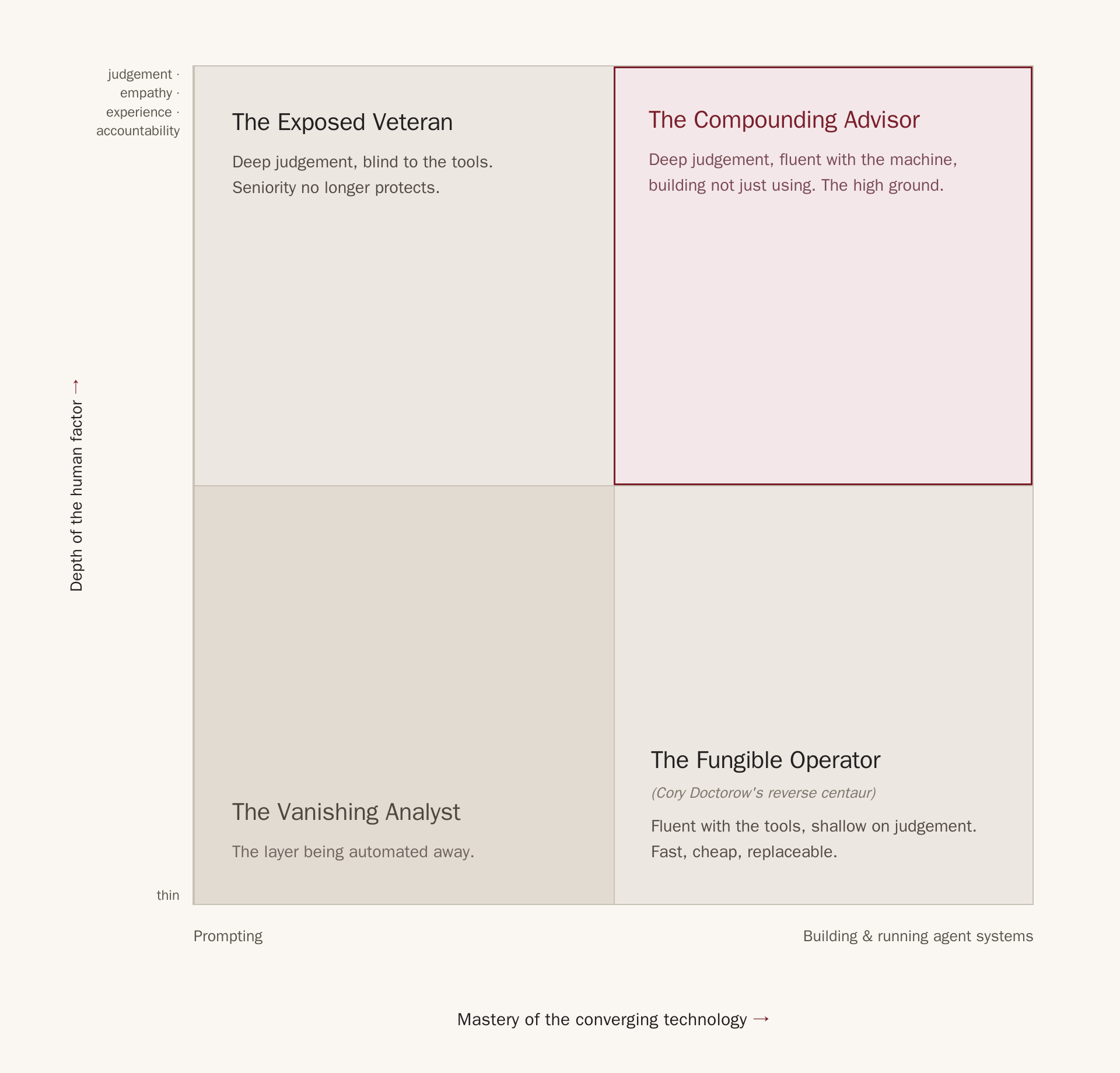
- High on both is the rare one: deep judgement, fluent with the machine, building rather than just using. That's where you want to be now.
- High on judgement but blind to the tools is the exposed veteran. The seniority, which used to protect, now marks you.
- Fluent with the tools but shallow on judgement is fast, cheap, and replaceable.
- Low on both is simply the layer being automated away.
A twenty-year partner stuck at prompting is more exposed than a manager who architects agent systems. That sentence would have been absurd five years ago but it's the new sorting, and it is already here.
The gravity, and a debt to Cory Doctorow
Here I owe a debt. The writer Cory Doctorow has given us the sharpest word for the danger in this picture: He calls it the reverse centaur.
The word comes from chess. After a computer beat him, Garry Kasparov went looking for what humans and machines might do together, and found something strange, Kasparov's Law: "a weak human player plus machine plus a better process is superior, not only to a very powerful machine, but most remarkably, to a strong human player plus machine plus an inferior process."² A human paired with a machine — a centaur — could beat the machine alone, as long as the human stayed in charge of the process.
Doctorow's point is that most AI builds the opposite. "A reverse centaur," he writes, "is a machine head on a human body, a person who is serving as a squishy meat appendage for an uncaring machine."³ Not a human helped by a machine, but a human harnessed to one: the warehouse picker, the gig driver, the coder doing the work of six laid-off colleagues at a pace that all but guarantees the output is defective, then blamed for the defects.
Three of the four corners on my little map are versions of losing to that development: automated away, harnessed to the machine, or stranded with judgement no one can reach. Doctorow describes all of that beautifully. What I am trying to add is the map of the one direction that resists it, the corner where you stay the rider. High on both axes. The work of staying a centaur in a world being built to make reverse centaurs of us.
It was never about consulting
This is not a consulting story. The stack is universal. Every profession is people, process, and tools; every profession is having its tools converged; every profession will re-sort on the same two axes. The radiologist who wields the AI and owns the read, against the one who rubber-stamps it. The lawyer whose judgement and client trust survive, against the one whose drafting was the whole job. The engineer who architects, against the one Doctorow already named. Different tools on the x-axis, the same human factor on the y, the same four corners, the same hill to climb.
That is why I stopped calling it a consulting thesis and started calling it the Watershed Effect, first in my head, now more publicly. Every few decades a trade reaches its watershed — the point where its tools converge, the water finds its level, and only the high ground stays dry. AI is ours. The consulting version is just the cross-section I happen to live in.
The second fight
Value is not the same as reward.
The model tells you where the value goes. It does not promise you will capture it. Capital can, and routinely does, extract the value created by the very people it has turned into reverse centaurs e.g., the picker creates enormous value and is paid to be watched. Standing on the high ground means you hold something scarce. Whether you are paid for it depends on ownership and bargaining power, which are a different fight. Doctorow is mostly writing about that second fight. I am writing about the first. You need to win both, and they are not the same.
Back to the junior
So, finally, to the young consultant who started all of this.
AI is not going to take your job. It will converge your tools down to a floor everyone stands on, and in doing so it will ask you a harder question than whether you are employed: It will ask who you are without your tools. What is left when the part of your work a machine can do is done by a machine? That remainder — your judgement, your read of people, your earned experience, your willingness to own the outcome — is the whole of your economic value now. It always was the most valuable part. Convergence merely stripped away everything that used to hide it.
The discipline I mentioned, those laws of AI delegation, turns out to be the practical other half of this. The Watershed Effect tells you where the value is. The laws are how you work with machines every day without quietly handing that value away, one delegated decision at a time. One is the map. The other is how you walk it.
I gave the junior the short version, and I'll leave you on it too. The tools are converging. They will keep converging, and the waterline will keep rising. And when they do, the only thing that tells any of us apart is the part the machine cannot take.
When tools converge, people make the difference.
Notes & Sources
- Accenture fell nearly 20% on 18 June 2026 — its worst single session as a public company — on a softer outlook and falling bookings, with analysts tying the move to AI pressure on consulting demand; Capgemini and Infosys were also down sharply for the year. Bloomberg, Accenture's Outlook Disappoints in Uncertain Consultancy Market (18 Jun 2026); The Motley Fool (18 Jun 2026); HFS Research.
- Garry Kasparov on "advanced chess" and human–machine "centaurs," Conversations with Tyler (2017); see also kasparov.com.
- Cory Doctorow coined "reverse centaur" (Pluralistic, 2021) and develops it in The Reverse Centaur's Guide to Life After AI (Farrar, Straus and Giroux, 2026). Definition quoted from Pluralistic: pluralistic.net/tag/reverse-centaurs
- Thomas H. Davenport, "Putting the Enterprise into the Enterprise System," Harvard Business Review 76, no. 4 (1998): 121–131.
- The laws of AI delegation referenced here are my own framework — the Three Laws of AI Delegation.